
Publication selected as Editor’s Choice: In Situ Synchrotron Diffraction Study of Magnesium Composites
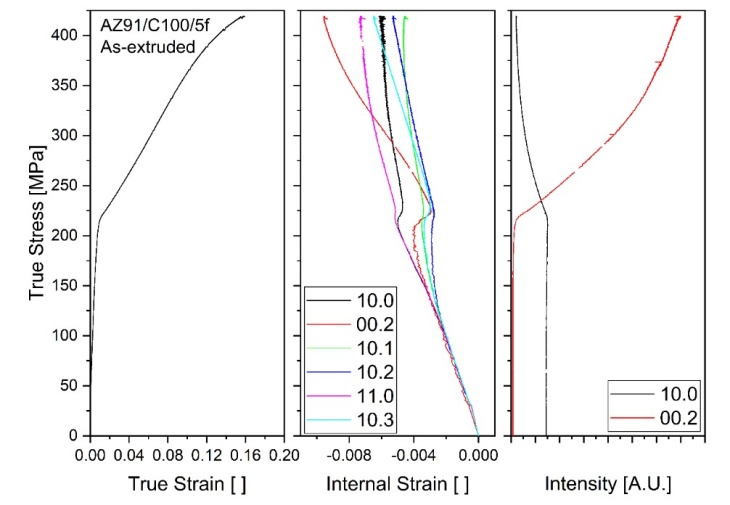
Macroscopic true strain (left), strain on lattice planes (centre), and intensity (right) against true stress for AZ91/C100/5f in as extruded state
Graphic: Hereon / Sophie Mance
Sustainability is an important consideration for manufacturers. One approach to improve on sustainability in the automotive and aerospace industries is to improve fuel efficiency by using lightweight materials. Magnesium is a promising candidate for these applications as it is lightweight, has a high specific strength, good machinability and castability. Alloying additions can further improve these properties as well as improving corrosion resistance and ductility. Metal-matrix composites (MMCs) using an Mg alloy matrix offer improved mechanical properties, whilst retaining Mg alloys’ light mass. Sustainability can also be considered when choosing the reinforcing addition. Recycled carbon fibres (rCFs) recovered from carbon-fibre-reinforced polymers maintain many of the mechanical properties of virgin CFs, but are cheaper and less energy intensive to produce. Finding uses for rCFs will also encourage more commercial recycling of carbon fibre reinforced composite materials. The colleagues of our Institute, with partners from the Institute of Material and Process Design and the University of Cambridge, utilized synchrotron radiation diffraction to understand how the heat treatments and CF reinforcement affect the active deformation mechanisms during to develop high-performance, sustainable composite materials. The corresponding publication has been selected as an Editor’s Choice Article in Crystals. Mance et al., Crystals 2022 12(11):1502